
Training hard is the easy part. Recovering well? That’s where the real gains live.
Whether you’re lifting heavy, running intervals, grinding through weekend matches, or just trying to keep up with your fitness routine, muscle soreness can slow everything down. A good recovery device can help you bounce back faster, move better, and feel less like you got hit by a truck after leg day.
But with so many gadgets promising “faster recovery,” which ones actually make sense? And how do you know if a device is worth your money, your time, and the space it will steal from your living room floor?
Let’s break it down in a simple, practical way.
Why muscle recovery matters more than most people think
Muscles don’t grow during the workout. They adapt during recovery. That’s when the body repairs tiny muscle fibers, restores energy stores, and reduces inflammation caused by training stress.
If recovery is poor, the result is usually familiar:
- Persistent soreness that lingers longer than it should
- Reduced performance in the next session
- Higher risk of overuse injuries
- Less motivation to train consistently
In other words, recovery isn’t a luxury. It’s part of the training plan.
That’s exactly why recovery devices have become so popular in sports and fitness. They offer targeted support that can help manage soreness, improve circulation, and speed up the “ready for next round” feeling.
What is a recovery device, exactly?
A recovery device is any tool designed to help the body recover more efficiently after exercise. Some devices focus on improving blood flow. Others reduce muscle tension, lower perceived soreness, or support relaxation after intense training.
The most common types include:
- Percussion massage guns
- Compression boots or sleeves
- Electrical muscle stimulation devices
- Cold therapy devices
- Heat therapy devices
- Foam rollers and vibration tools
Each one works a little differently, and each has its own sweet spot. The best choice depends on your sport, your recovery habits, and the areas of your body that tend to complain the loudest.
Percussion massage guns: the crowd favorite
If recovery devices had a poster child, it would probably be the massage gun. These handheld tools deliver rapid pulses into the muscle tissue, creating a deep-tissue massage effect that can help ease tightness and improve blood flow.
They’re popular for a reason. They’re easy to use, fast, and surprisingly effective for people who feel stiff after workouts or long training days.
Best for:
- Quads after leg day
- Glutes after sprint work
- Calves after running or jumping
- Upper back and shoulders after heavy lifting
Anecdotally, many athletes use them before training too, especially as part of a warm-up routine. A few minutes on tight areas can help the body feel more mobile before the first rep or first stride.
What to watch for? More power is not always better. If a device is so aggressive it makes you tense up, that’s not recovery — that’s a tiny home demolition project. Look for adjustable speeds, comfortable attachments, and a battery that lasts long enough for your actual routine.
Compression boots: recovery for people who stand, run, and suffer politely
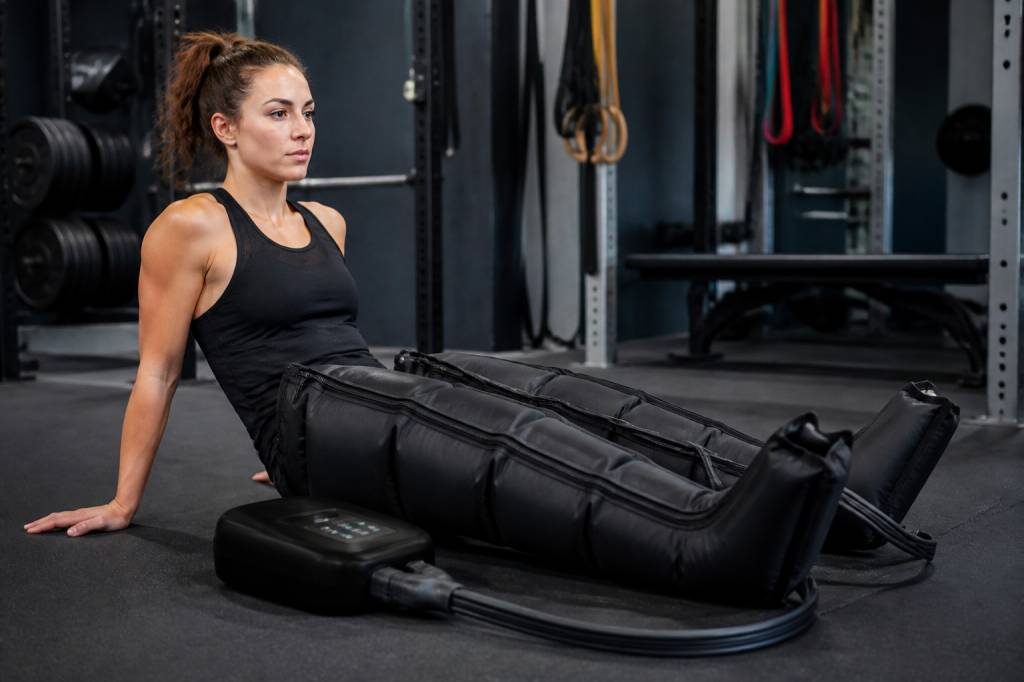
Compression boots are those inflatable sleeves that wrap around your legs and rhythmically squeeze them in cycles. They’re especially popular among runners, cyclists, basketball players, and anyone whose sport heavily loads the lower body.
The idea is simple: rhythmic compression helps support circulation and may assist with reducing post-workout heaviness. Many users report that their legs feel lighter and fresher after a session.
These devices are particularly appealing if you regularly deal with:
- Heavy legs after long runs
- Swelling after travel or tournaments
- Fatigue from repeated lower-body sessions
- Back-to-back training days
They’re not cheap, but for athletes who train frequently, the convenience can be hard to beat. Put them on, sit back, answer a few emails, and let technology do the legwork. Literally.
Electrical muscle stimulation: useful, but not magical
Electrical muscle stimulation, often called EMS or TENS depending on the purpose, uses small electrical pulses to stimulate muscles or nerves. Some devices are designed to help with muscle activation, while others are used more for pain relief or relaxation.
In the recovery context, EMS can be helpful for loosening up muscles, supporting circulation, and reducing the sensation of tightness after training. It’s often used by athletes, physiotherapists, and rehab professionals.
It can be a smart option if you want something more targeted, especially for:
- Small muscle groups like calves or forearms
- Post-session relaxation
- Active recovery on rest days
That said, EMS should be used with a little respect. It’s not a shortcut that replaces sleep, nutrition, and proper training load management. Think of it as a helper, not the whole strategy.
Cold therapy and heat therapy: old-school methods with modern tools
Not every recovery device has a motor, a screen, or Bluetooth. Sometimes the classics still get the job done.
Cold therapy devices — such as cold packs, ice compression wraps, or portable cooling systems — are often used after intense exercise to help reduce discomfort and calm down irritated tissue. Heat therapy devices do the opposite: they help relax tight muscles, increase blood flow, and can feel especially good on stiff areas.
When should you use which?
- Cold: after intense sessions, if you want to ease soreness or manage swelling
- Heat: before activity, or when muscles feel tight and need loosening
There’s no need to turn your home into a sports medicine lab. A simple heated wrap for the lower back or a cold compression sleeve for the knee can make a real difference when used consistently.
Foam rollers and vibration tools: simple, affordable, effective
Foam rollers don’t always get the flashy attention, but they’ve earned their place in serious recovery routines. By applying your body weight to targeted areas, you can work on muscle tension, mobility, and general tissue comfort.
Vibration rollers take that a step further with added oscillation. The sensation may help some people tolerate pressure better and feel more relaxed afterward.
They’re especially useful for:
- Calves that feel like concrete
- IT bands and outer thighs
- Back and glutes
- Warm-ups before training
The best thing about foam rollers? They’re affordable, portable, and basically impossible to “outgrow” as a fitness tool. You can use them at home, in the gym, or even while pretending to watch a match on TV.
How to choose the right recovery device for your sport
The best recovery device depends on the type of training you do and the areas that usually get hammered.
If you’re a runner, your lower body probably needs the most attention. Compression boots, calf-focused massage tools, and heat or cold therapy can all be strong options.
If you lift weights, a massage gun and foam roller might be enough to help with muscle tightness in the back, shoulders, glutes, and legs.
If you play team sports, recovery often comes down to convenience. You need something that fits between training, games, work, and whatever else life throws at you. Portable tools and quick-use devices tend to win here.
Ask yourself:
- Which muscles are always sore?
- Do I want something for daily use or only after hard sessions?
- Will I actually use a larger device, or will it collect dust?
- Do I need a recovery tool, or do I need better sleep and hydration first?
That last question matters more than brands often admit.
What actually makes recovery faster?
A recovery device can help, but it works best inside a bigger system. No gadget can fully compensate for poor habits.
To speed up muscle recovery, keep the basics in place:
- Sleep: the body repairs itself best when you’re not checking your phone at 1:00 a.m.
- Hydration: muscles function better when fluid balance is solid
- Protein and carbs: give the body what it needs to rebuild and restore energy
- Training load management: recovery is easier when every session isn’t a death match
- Active recovery: walking, light cycling, mobility work, and stretching can all help
Think of the device as the support act. The main show is still your daily habits.
Common mistakes people make with recovery devices
Recovery tools are useful, but they’re easy to misuse. A few common mistakes can reduce the benefits or simply waste your time.
- Using too much pressure: more intensity does not equal better recovery
- Spending too long on one area: ten thoughtful minutes beat thirty random ones
- Skipping the basics: no device can replace sleep and nutrition
- Buying for hype, not need: the fanciest option is not always the smartest one
- Using it inconsistently: recovery works best when it becomes routine
Consistency is the hidden cheat code. Not glamorous, but very effective.
Are recovery devices worth the investment?
For many athletes and fitness enthusiasts, yes — if the device matches a real need.
If you train a few times a week and deal with mild soreness, a foam roller or massage gun may be enough. If you train hard, compete often, or spend long hours on your feet, a compression system or more advanced recovery device could be worth it.
The return on investment is not just “feeling less sore.” It’s also about training consistency, better movement quality, and fewer interruptions caused by fatigue or stiffness.
That said, don’t buy a recovery device because an ad made it look like a miracle. Buy it because it solves a problem you actually have.
Where recovery fits into a smart sports routine
The athletes who recover well usually train better over time. That’s not magic. It’s just smart planning.
A simple recovery routine after training might look like this:
- 5 to 10 minutes of cool-down movement
- Hydration and a post-workout meal or snack
- 10 to 15 minutes with a recovery device on targeted muscles
- Light stretching or mobility work if needed
- Good sleep later that night
That routine doesn’t need to be complicated. It just needs to be repeatable.
In sports and fitness, progress is often built in the small spaces between sessions. A recovery device won’t do the work for you, but it can help make those spaces count.
And if your legs feel fresher, your shoulders stop grumbling, and your next workout starts with less stiffness? That’s a win worth keeping.